This article shows you how to create a new audit issue, which fields are available, and how to reuse the catalog of criteria from an existing audit.
Create an audit
Create a new issue of the type Audit. The following fields are available:
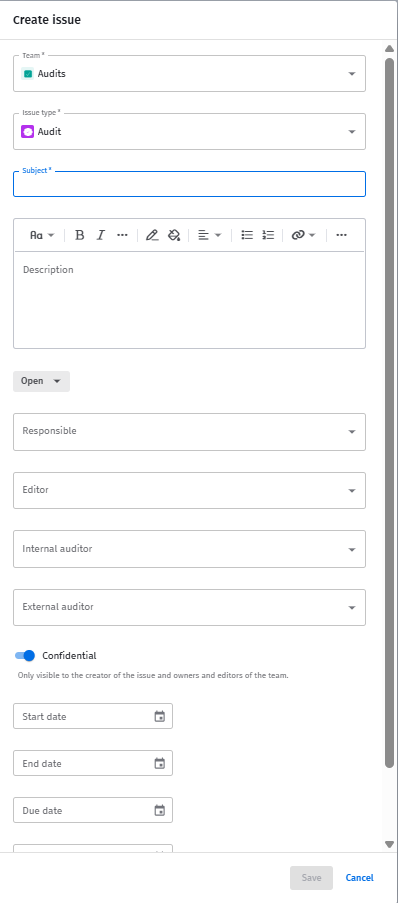
- Subject: required
- Description: description of the audit
- Status further information here > Audit statuses
- Responsible: the person(s) responsible for the audit
- Editor: the person(s) responsible for preparation and follow-up
- Auditor: the person conducting the audit — either an internal user or details of an external person
- Confidential: sets whether the audit issue is visible to all team members or only to owners and editors
- Audit start and end: the period during which the audit is scheduled to take place
- Due date: free to use, for example if follow-up must be completed by a specific date
- Follow-up date: free to use, for example as a reminder to start preparation in good time before the audit start
Reuse the catalog of criteria from a previous audit
You can reuse the catalog of criteria from an existing audit in a new audit — even if no audit template exists for it.
On new audit issues that don't yet have a catalog of criteria, you can use the Add catalog of criteria function to reuse the catalog from an existing audit.

Good to know: Audits can also be selected across teams — your permissions are taken into account.
The original audit's existing data is handled as follows:
- The audit's catalog of criteria is carried over.
- pages linked to the criteria is carried over.
- Attachments (files, pages) on the audit issue itself are not carried over.
- Issue links are not carried over — neither from the audit itself nor from individual criteria.
Related articles
Was this article helpful?
That’s Great!
Thank you for your feedback
Sorry! We couldn't be helpful
Thank you for your feedback
Feedback sent
We appreciate your effort and will try to fix the article