Audit templates let you carry out recurring audits based on the same catalog of criteria every time. This article shows you how to create audit templates, build the catalog of criteria, and import it from an Excel file if needed.
Create audit templates
Use audit templates to create a template for a typical audit.
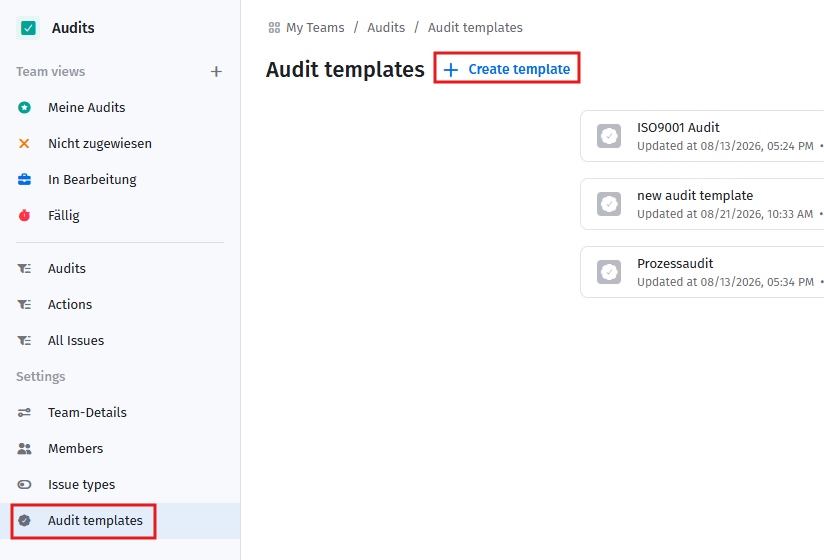
- In the team menu, open the Audit templates section.
- Click on +create template
- Enter a title and description so you can easily find the template later.
- Click Save.
- Then create your catalog of criteri or import a pre-made catalog.
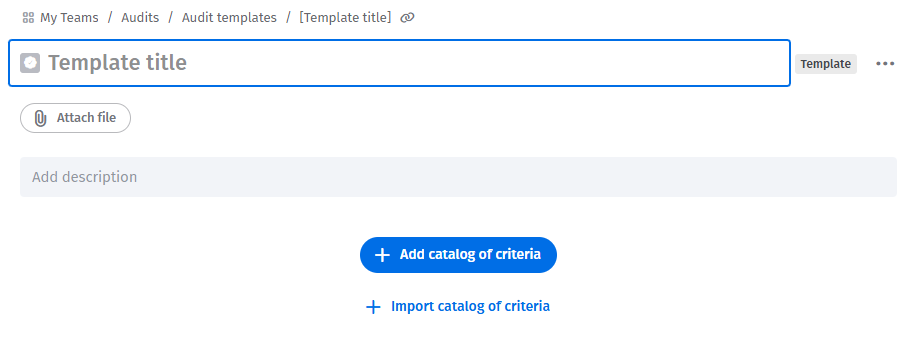
Use Attach file to add extra information to the template, such as notes or explanations from an external auditor. These attachments are automatically carried over to the created audit issue whenever the template is used.
Build the catalog of criteria
The catalog of criteria is created in the audit template and can later be selected on the audit issue. It consists of sections, which in turn contain criteria.
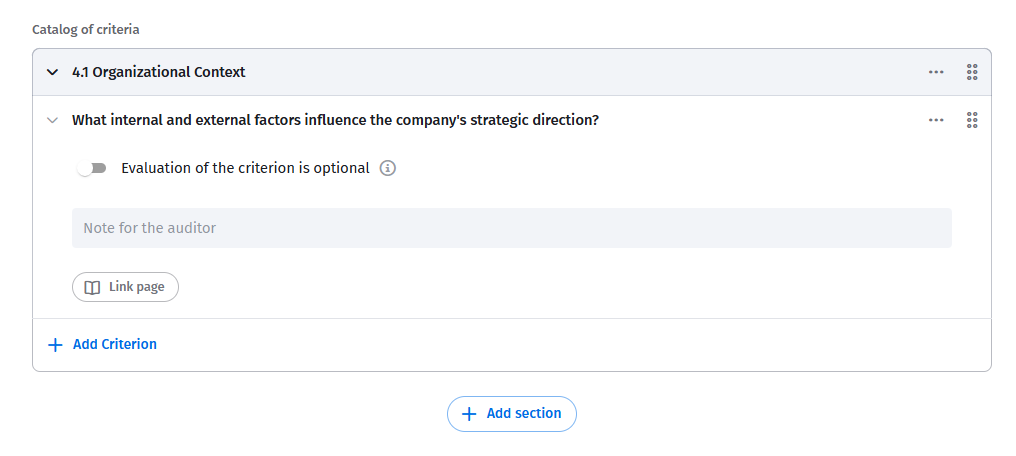
Each criterion has the following properties:
- A title
- Whether the criterion must be answered or can be skipped by the auditor (optional)
- A note displayed to the auditor below the criterion
- The option to link pages
The Link page option is available both on the audit itself and on individual criteria. This lets you attach relevant manual content in the template already — it's carried over to the actual audit whenever the template is used.
Edit and delete the catalog of criteria
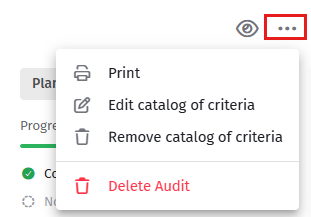
Once the catalog of criteria has been created, you can edit or delete it afterward. Use the three-dot menu with the options Print, Edit catalog of criteria, and Remove catalog of criteria.
Import a catalog of criteria into the audit module
Prepared catalogs of criteria can simply be imported from an Excel file. This saves time and ensures a consistent standard across your audits.
Step by step
- Create a new audit template:Open the audit module and create a new audit template in your team. Enter a title and description.
- Click "Import catalog of criteria": In the template, you'll find the Import catalog of criteriaoption. Click it to start the import wizard.
- Select the prepared Excel file: Choose the file from your computer, or use drag and drop. Make sure it's in xlsx or xlsformat.
- Use the Excel template at the end of this help article.
- Upload and review: Upload the file using Import, then check that all sections and criteria were carried over as expected. You can adjust them directly in the template if needed.
- Four columns required: The import expects the columns Section (max. 300 characters), Criterion (max. 300 characters), Note (max. 100,000 characters), and Optional.
- Columns A and B must be filled in: "Section" and "Criterion" are required columns. Only correctly named columns are recognized — mismatches will cause the import to fail.
- Optional is controlled via 0 or 1: Enter 1 in the corresponding cell in column D to mark a criterion as optional.
- Empty rows are ignored: Rows without content are simply skipped during import.
- Avoid special characters or emojis: Characters like & % # ; "" or emojis can cause issues when reading the file and should be removed.
Related articles
Was this article helpful?
That’s Great!
Thank you for your feedback
Sorry! We couldn't be helpful
Thank you for your feedback
Feedback sent
We appreciate your effort and will try to fix the article